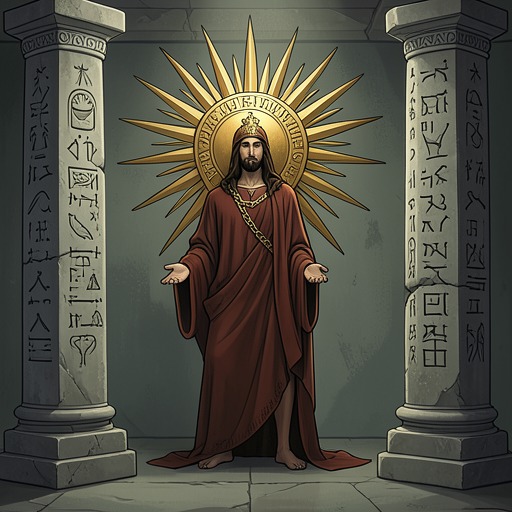
Nature Absorption Academy’s Sun Worship
The Hanging GirlNature Absorption Academy’s Sun Worship joins nature-centered teaching to solar imagery and collective ritual, presenting the sun as a life-giving power through which people may find renewal and a place in the universe. Its recurring chants, guided bodily exercises, sacred stones, and reverent assemblies turn that teaching into a shared practice. Yet the ceremonies also make visible the authority concentrated in Atu Abanshamash Dumuzi and the roles assigned within his community: the language of universal fellowship sits alongside hierarchy, personal devotion, and a public transfer of spiritual status to Pirjo.
Teaching and Spiritual Language
At the Nature Absorption Academy London Branch, Atu’s appeal is presented as something more immediate than formal doctrine. He does not appear as a remote guru seated in an elevated chair. Instead, he moves among people sitting on the floor, speaking of nature absorption as a way to feel renewed, as if every cell could resist attack and the body could melt into the surrounding universe. The sun’s energy and the universe form the center of his message. His repeated invocation of “Abanshamash” gives the teaching a memorable spoken form, while the group’s participation makes listening an act of belonging.
At the Academy, this nature-centered outlook is framed partly through a rejection of competing spiritual systems. In a gathering for newcomers, Atu says their previous spiritual paths have no significance in this place and that they have not come to concentrate on their own souls, consciousness, dogmas, or creeds. He presents their purpose instead as learning “to be.” Horus, he explains, gathers human attempts to understand where people come from and why; invoking the name expresses thanks for the gifts of life and nature. He also describes the daily practices as rituals with simple, durable means, intended to foster peace of mind, compassion, love of fellow human beings, and the ability to meet the future and assess the past without despair. The account thus places the Academy’s solar language within a broader claim about life, nature, and ethical conduct, rather than treating it simply as worship of a deity.
Ritual, Place, and Collective Experience
The Academy’s practice gains force from its settings and repeated forms. Its buildings stand close to the sea, with glass domes and ordered grounds; an open area contains a timber circle resembling examples associated with Bornholm. In the hall, skylight falls across a glass-tiled section of floor where Atu is expected to stand, giving the space a bright, golden focus before the ceremony begins. Disciples sit silently and wait for him, and his sessions are described as the day’s high point, whether held indoors or on the beach at dawn. The repeated gathering makes devotion part of the community’s ordinary rhythm.
During one assembly, Atu rocks with his arms spread and begins the “Abanshamash” chant alone before the group joins in. In another, he chants to a crowd that it can feel him and that together they will feel Malena and draw out her pain, although Pirjo notices Malena is absent. That moment shows how communal ritual can claim to act on behalf of someone who is not present. Later, the assembly’s chant shifts to “Horus, Horus, Horus,” as disciples rock together. The invocation links a repeated bodily movement to the Academy’s stated spiritual vocabulary, making shared participation itself part of the ceremony’s persuasive effect.
Sacred Names and Objects
The Academy also gives its beliefs material and linguistic form. When Carl asks about Atu’s name, a woman at the center explains its claimed Sumerian components: “Atu” means guardian, “Aban” stone, “Shamash” sun or celestial body, and “Dumuzi” is parsed through words for son and spirit or life. She translates the full name as “Guardian of the sunstone, lifespirit’s son.” The explanation turns the leader’s name into a compact statement of his supposed role, joining guardianship, stone, sun, and spiritual life. Carl privately dismisses the explanation, establishing a skeptical counterpoint to the reverence with which it is offered.
At a later ceremony, Atu announces that he has learned the name of his and Pirjo’s child through Zini, described as the spirit of the wind. He names Amaterasu as the prospective girl’s name and Amelnaru as the boy’s, attaching each to a public spiritual meaning. He then asks Pirjo to become guardian of two sunstones: one associated with Knarhøj and another, an amulet from Rispebjerg, said to bind the group to its ancestors and their faith. The stones make continuity with place and ancestry tangible, while their transfer appoints Pirjo to a defined sacred responsibility. Atu places his cloak over her shoulders; the assembly’s response and her visible emotion show that the gesture is received as more than a private exchange.
Authority and Narrative Significance
The ceremonies portray an institution built around Atu’s presence. Before one meeting, Pirjo, dressed in white, arranges the disciples according to rank and association; only afterward does Atu enter. Her administrative work helps order the assembly, while his arrival provides its spiritual center. In another gathering he smiles down at the people like a father, and they wait expectantly for his words. His authority is therefore staged through more than teaching: it is supported by the assembled followers, the prepared space, repeated chanting, and the roles through which the group organizes itself.
The narrative also places that appeal under scrutiny. Carl and Assad recognize Atu as the man they have been seeking, and Carl reads the end of the performance as demagogy, comparing its persuasive force to political appeals that claim a superior understanding of the world. He can see that the Academy’s language of nature, peace, and fellowship may be sincerely offered; he also fears what such personal influence could become if a leader were willing to do anything to defend his project. His question about whether Alberte had become an obstacle to that project remains a suspicion, not an established explanation. The contrast matters: the same ritual that offers followers unity and meaning appears to the investigators as a possible instrument of influence, keeping the Academy’s promise of harmony in tension with the power gathered around its leader.